I love watching films, I always have. I love how they spark our imagination and leave messages with us long after the credits roll. Through conversations with like-minded friends, the topic of environmentalism in film has cropped up a few times. Film is, after all, a medium for sharing ideas and embedding deeper meanings within entertainment.
In recent years, climate change and ecosystem collapse have featured directly or indirectly in numerous films. Many futuristic sci-fi films are set in worlds shaped by the collapse of Earth’s ecosystems. For example, the movie Don’t Look Up (2021) served as a direct allegory for climate denial and Blade Runner (1982) depicts a world shaped by severe ecological collapse.

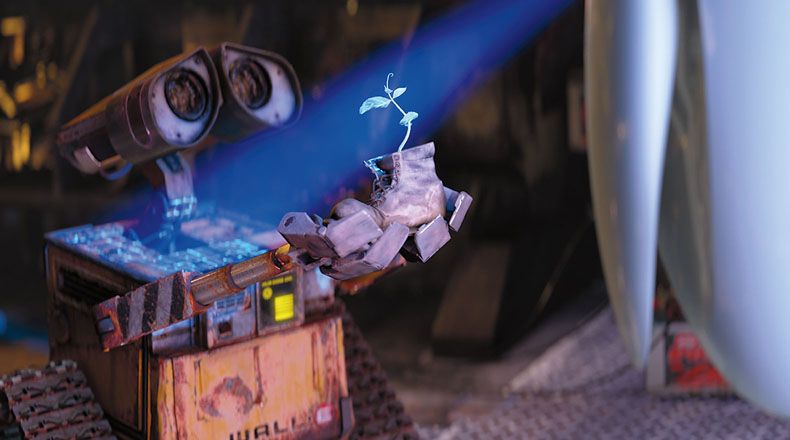
When thinking more on the topic, several children’s films from my youth relay similar themes. The obvious contender is Dr Seuss’ The Lorax (2012), in which the titular character is a guardian of the forest who speaks for the trees in an effort to curb a capitalist venture. I think also of Over the Hedge (2006) presenting relentless urban development in American suburbia and the robot WALL-E (2008) compacting rubbish on a deserted Earth.
These family films contain important messages about protecting nature, most often from the villainy of human activity. It seems an interesting placement to involve such stark messaging in films designed for young children. Are they instilling positive messages from early on, simply making children aware of environmental topics, or potentially encouraging the beginnings of climate anxiety through disturbing visuals of an earth in ecological ruin?

To look more closely at this subject, I intend to write a 3-part mini-series of blog articles. They will explore the representations of idealised ecosystems at a distance, human-nature relationships closer to home, and the psychological load of environmental messaging for young audiences. Without further ado, here is the first instalment:
1.Selling Utopia: Promoting stewardship
This, the first blog in the series, looks at the presentation of natural spaces in kids’ films as beautifully pristine areas worthy of protection. Utopian landscapes crop up in children’s films as a distant hope or historic oasis that has long been lost. They serve as idealised places in which nature exists without disruption or humans are able to coexist in balance. It’s somewhat demoralising to think that, for some children, modern animation may be one of the few ways they encounter rich, diverse ecosystems that they struggle to access in their own lives. In some ways these films provide the source material for a world that children would want to protect, in a dystopian adjacent reality to the real-world problems around us.

It is clear that any films highlighting issues in nature are making the environment visible in children’s lives. They are important simply in their ability to distil a message, regardless of the form that message takes. The most memorable song in the Lorax preaches to “let it grow”, a call to action to allow trees to thrive in the wake of mass deforestation. The bright and colourful fictional oasis that is lost provides visual motivation to protect beauty in the natural world. Whilst it depicts a world very unlike our own, the moral is transferrable. Some researchers have also commented on the role animations play in socialising children to environmental issues and crises. As a bridge to understanding these issues in depth later in life, perhaps it is acceptable that they perpetuate some inaccuracies and skip over many technicalities. Perhaps we should take The Lorax at its core message: to be a steward and speak for the trees.
Focussing in on this common thread of utopia- the idea of a place or state of things where everything is perfect- each story describes it in different proximities to humans. In the Lorax, we witness a utopian picture of wildlife and trees be lost in recent history beyond the walls of the city. In Happy Feet, humans are framed as being responsible for a geographically distant utopia- a seemingly untouched Antarctic landscape home to many groups of penguins. The utopian landscape is disrupted when Mumble swims past elements of a commercial fishing industry, reminding the audience of humanity’s reach. In another childhood classic WALL-E, glimpses of a past earth are fleeting in the wake of the deserted uninhabitable Earth in 2805. The friendly robot is the last standing tasked with cleaning up the wreckage of ecocide 700 years prior. In this film, a utopian state is used in the past to emphasise the loss of such places.

In all examples, nature is depicted as something to protect. Messaging is important, but children learn well from witnessing action and behaviours around them. These sweeping messages tied into film plots popularise environmental issues in media but also run the risk of trivialising them. After all, it takes a song and one child’s ambition to overturn years of capitalist greed and destruction of the surrounding environment in the Lorax.

Similarly in the film Happy Feet, humans are portrayed as the clear cause of the penguin colony’s issues regarding overfishing and pollution. In the last act of the film when humans are captivated by Mumble’s dancing through viral videos, they change their tune and, through a montage of seamless UN style meetings, resolve to simply stop overfishing the seas. Humans are simultaneously cast as villains and fast heroes when they are shown their misdoings. These plotlines reach solutions in ways conducive to keeping a family film well-paced and comprehensible. I would agree that a realistic depiction of nations debating catch limits, dissecting satellite data, and negotiating government subsidies would make for a longwinded and potentially less enjoyable penguin-based children’s film. My point really is that we should be striving to distil useful messages into films for young audiences without promoting false ideas of political systems’ willingness and capacity to straightforwardly choose and do the right thing.
In all cases, a message is found in the loss or protection of natural beauty. Whilst simplistic solutions are problematic in giving audiences false hope of an easy fix, I think there is a deeper issue in the kind of nature children are being encouraged to protect and the distance put between us and it.
Utopia is never present alongside humans. We are not a part of ecosystems in balance.
In all three stories, humans are presented to children as beings that destroy idyllic natural environments; there is a clear separation. Most notably, The Lorax depicts nature as a desirable but ultimately unnecessary accessory to human life, existing outside the city’s walls. A key motivation for the community to bring them back is their ability to cheapen day-to-day life as they produce cleaner air for free.

These films reinforce an ideology of humans and nature as separate entities, a way of thinking that has accelerated many civilisations’ move to commodify and exploit natural environments. Aspects of human society across the world have unequivocally destroyed and redefined the limits of nature. Generalising all humans to be cogs in our shared machine of destruction is potentially damaging in inspiring inaction and despair among audiences. It is this human-over-nature narrative that removes hope of us existing with the environment. Pitting humans as separate to or above nature suggests that we can never be interwoven with the utopian states described. What hope is there to glean from that messaging?
In essence, the message is that nature is beautiful and therefore we should protect it. However, nature is separate from humans and therefore these films inadvertently reinforce the human/nature binary that underpins so many systems of exploitation.
We need creativity, hope, and imagination to continue to face the environmental crisis. We also need our younger generations to develop an interest in advocating for the natural world. These films hold power in the way they connect with young minds, the messaging fed into them therefore should be considered. The ideal messaging is of course subjective and up for debate. I believe we could gain a lot by encouraging the idea of collaboration and existence for humanity as a part of nature, not a race separate to it. We are affected by the decline in ecosystem health and as such are inseparable from it. The less we consider ourselves above or removed from the consequence of ecological collapse, the better. We cannot hope for a better future ahead without standing with the ecosystems our species has forced into decline.
Maybe the real conclusion is to support diverse filmmakers with differing perspectives and worldviews. Children are intelligent and capable of making judgements and taking messages from media they consume. More stories that interweave humans with nature could give children something to take forward: an ideology of collaboration over commodification. It would be a start.
Useful references
- Kylie Caraway & Brett R. Caraway (2020) Representing Ecological Crises in Children’s Media: An Analysis of The Lorax and Wall-E, Environmental Communication, 14:5,686-697, DOI:10.1080/17524032.2019.1710226
- Mizan-Rahman, Mohammad. ““Unless someone like you cares a whole awful lot, nothing is going to get better”: an environmental discourse analysis of animated films The Lorax (2012) and Tomorrow (2019).” Geoscience Communication 7.1 (2024): 63-79.

Leave a Reply